
How to Reduce USCIS RFEs with Document Automation in 2026
Receiving a Request for Evidence from USCIS is a gut punch to your immigration practice. A single RFE halts your case, adds 60 to 90 days of processing delay, spikes your client's anxiety, and consumes hours of unbillable paralegal time. If you run a high-volume H-1B, O-1, or family-based practice, managing RFEs can start to feel like playing defense against a moving target you can never quite see.
In 2026, trying to solve this with a manual pre-filing "quality control" check is a losing strategy. Policy shifts, form edition updates, and sheer case volume make human-only review highly vulnerable to the exact errors that trigger avoidable RFEs.
The firms gaining ground in this environment aren't just telling their paralegals to "double-check the paperwork." They are building immigration law firm document management automation: a data-validated pipeline that catches missing evidence, outdated form editions, and incomplete signatures before a single page is submitted to USCIS.
This post walks through exactly how that pipeline works.
The 2026 RFE Environment: Why Volume Alone Is Breaking the Process
The adjudicatory climate has shifted considerably since early 2025.
According to AILA and Fragomen's 2025 mid-year review, RFE rates for H-1B extensions and transfers rose from roughly 9% (the multi-year low reached under the prior administration) to over 30% by early 2026. (Source: WayLit, citing AILA/Fragomen 2025 mid-year review) O-1 petitions tell a similar story: USCIS data for FY 2025 shows 19.7% of completed O-1 cases received an RFE, which is nearly one in five. (Source: USCIS FY2025 data via Manifest Law)
Compounding this, USCIS has added two significant compliance pressures in 2026:
Form I-129 edition cutoff. On February 27, 2026, USCIS released a new edition of Form I-129 (dated 02/27/26). Starting April 1, 2026, USCIS rejects any petition still using the prior 01/20/25 edition. This is a hard cutoff with no grace period. (Source: USCIS.gov Forms Updates)
Signature denial rule. In May 2026, DHS published an interim final rule (effective July 10, 2026) formally giving USCIS adjudicators the authority to deny, not just reject, benefit requests with invalid signatures, even after a case has been accepted and receipted. A denial, unlike a rejection, means USCIS retains the filing fee entirely. The specific issue is the growing use of digitally copy-pasted signature images on paper forms; properly scanned copies of an originally handwritten signature remain acceptable. Signature-related denials rose from 300 in FY 2021 to 2,953 in FY 2025, a nearly tenfold increase. (Source: Federal Register, DHS Interim Final Rule, May 11, 2026)
When your staff is juggling 15 open browser tabs and suffering from the kind of cognitive overload we covered in our Tech Fatigue and Staff Retention post, these errors are not a matter of effort. They are a matter of volume. Human-only review at scale will produce these mistakes.
The "Pre-Filing Black Box" vs. The Automated Document Pipeline
In a disconnected firm, pre-filing quality control is a black box. A senior paralegal sits down the night before a filing and manually flips through a 300-page packet. They are searching for missing translation certifications, empty fields, and biographical inconsistencies. It is exhausting, highly subjective, and completely invisible to the case management system.
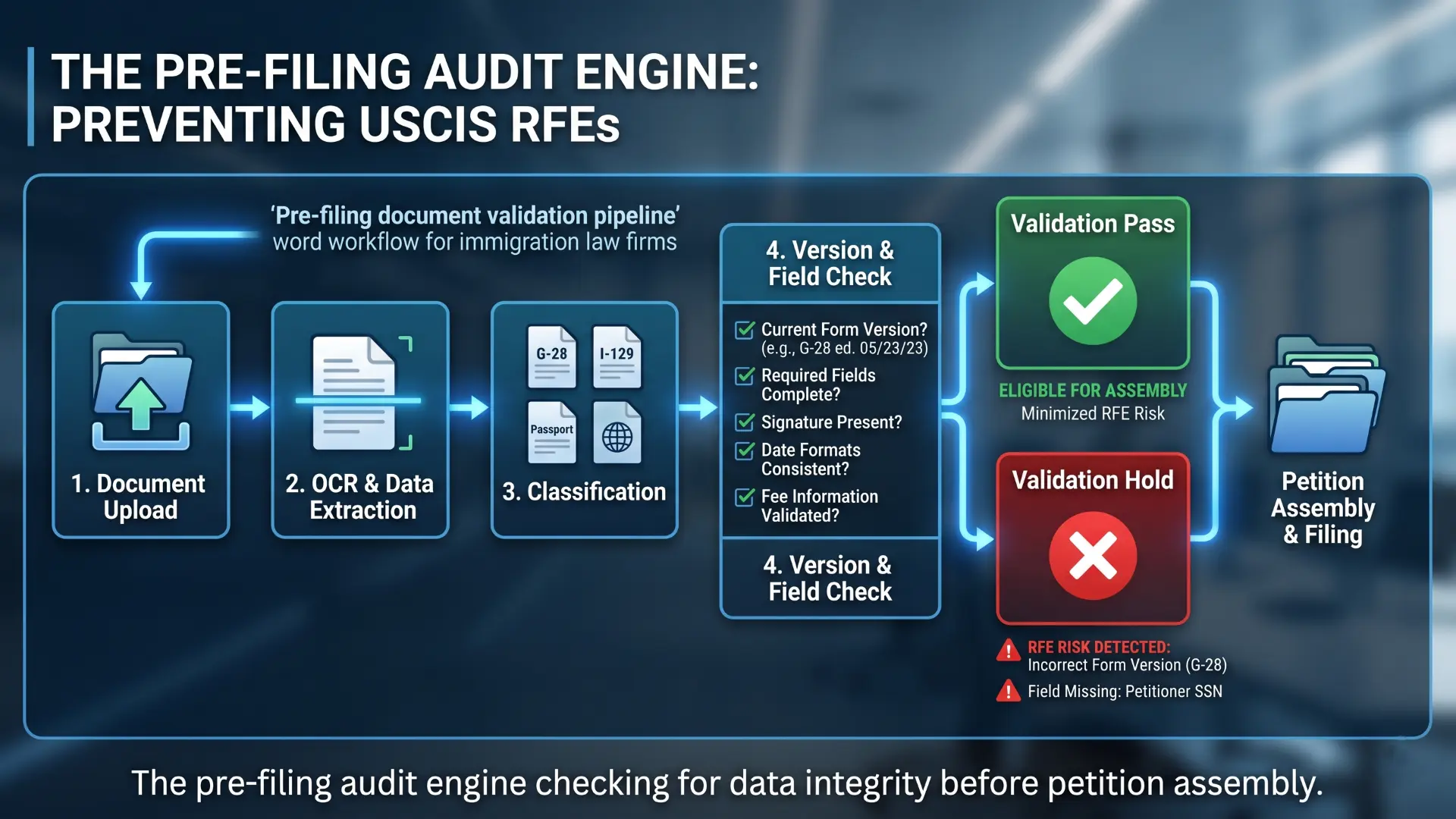
An automated document pipeline replaces that subjective check with a programmatic validation engine. Here is the actual technical architecture.
Stage 1: Messaging-Based Intake - Solving the Gathering Gap
Clients do not reliably use secure portal systems. General SMS open rates run around 98%, versus roughly 20% for email marketing messages, a ratio that holds broadly in legal client communications as well. (Source: Forbes / Infobip SMS Marketing Statistics)
Instead of waiting for a client to log in to a portal, the automation sends a secure, one-time upload link directly to their phone. The client photographs their birth certificate or experience letter. That document is immediately pulled into your CRM (HubSpot, GoHighLevel, or Clio) and logged against the specific document checklist for that case.
No portal login. No email tag.

Stage 2: OCR Classification - Catching the Wrong Document Instantly
The system does not simply accept whatever file the client uploads. Using Optical Character Recognition (OCR), it classifies the document type against what was requested.
If a client uploads a driver's license when the system expected a passport, the automation flags it immediately and sends an automatic correction message: "It looks like you uploaded a driver's license. Please upload a clear photo of your passport photo page instead."
Your paralegal is not involved until a clean, verified document is in the record.
Stage 3: Version-Control and Rule Validation - The Pre-Filing Audit
Before the petition is assembled, the automation runs a series of programmatic checks:
Form Edition Check. The system verifies the form against the current USCIS-accepted edition. Any outdated version, like the 01/20/25 edition of Form I-129 after the April 1, 2026 cutoff, is flagged and blocked from the pipeline.
Required Field Audit. The compiled PDF is scanned for empty fields. If a required field (such as a prior alien registration number or employer EIN) is blank, the pipeline locks.
Signature Validation. The system checks that signature fields are populated and structurally intact: not corrupted, not copy-pasted image files, and not blank. Given that signature-related denials have surged 887% since FY 2021, this check alone is worth the entire automation investment.

The Real Cost of an RFE: Running the Numbers
Managing partners often treat RFEs as an unavoidable cost of immigration practice. They are not. Every non-substantive RFE is a direct, calculable drain on your firm.
Here is a conservative estimate using realistic 2026 labor figures for a mid-sized business immigration practice:
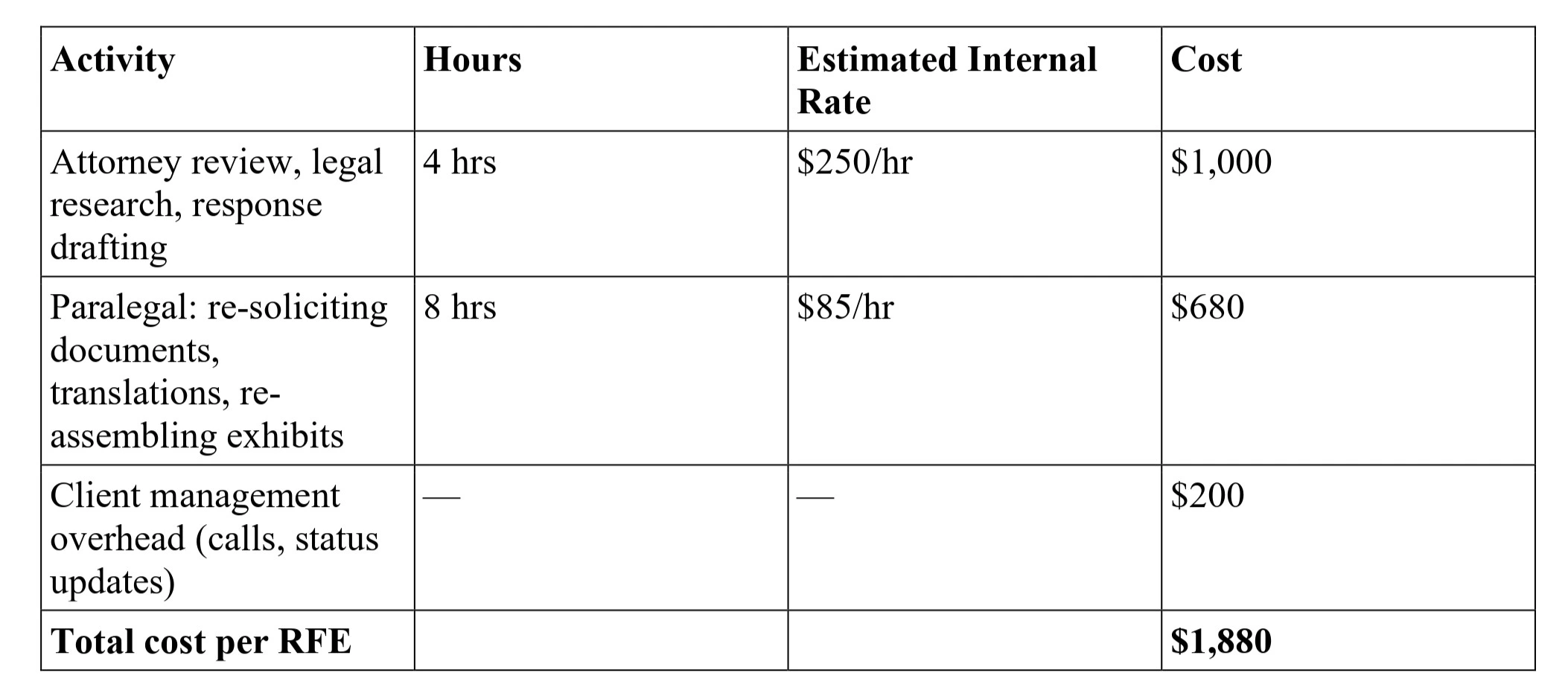
If your firm files 300 employment-based petitions per year with a 30% RFE rate (90 RFEs), the annual unbillable cost is approximately $169,200, before you factor in client relationship damage, delayed renewals, and the stress placed on your team.
This is what we call the RFE Tax. And it is largely preventable when the cause is administrative rather than substantive.
The CRM as a Pre-Filing Shield
The entire validation workflow above only holds if your CRM is configured to enforce it.
In a unified tech stack, every required document is treated as an individual record linked to the case, with a tracked Evidence Status field: Pending → Uploaded → OCR-Verified → Approved. The critical operational rule is simple: the pipeline cannot advance to "Ready for Filing" while any required document remains in "Pending" status.
If a case manager can drag a deal stage to "Ready for Filing" while the client's marriage certificate is still missing a certified translation, your CRM is giving you a false sense of readiness. By building API-level guardrails into HubSpot or GoHighLevel (hard rules, not soft reminders) you protect your team from the cognitive fatigue that causes these failures and ensure no incomplete petition leaves your office.

At Wacmediya, we build and configure these CRM guardrails, OCR classification layers, automated messaging pipelines, and form version-control checks for immigration firms. It is not a software product you buy. It is a custom-configured tech stack that runs as a managed service around your existing platforms.
Conclusion: Stop Responding to RFEs. Start Preventing Them.
In the 2026 adjudicatory environment (elevated H-1B scrutiny, a mandatory Form I-129 edition cutoff, and a new USCIS rule that allows denial and fee forfeiture for signature errors) your pre-filing process cannot be a Thursday-night manual review.
Immigration law firm document management automation turns your tech stack into an active defense mechanism. It catches the administrative mistakes (wrong form editions, empty required fields, missing translations, invalid signatures) that trigger non-substantive RFEs before a petition ever reaches USCIS.
If you want to audit your firm's current pre-filing workflow and identify where your exposure is, let's talk. We will walk through your intake-to-filing pipeline, identify the gaps, and show you exactly what a validated document pipeline looks like in practice.
FAQ: Document Automation and RFE Reduction
How can an automated system detect if a translation certification is missing?
The OCR engine classifies uploaded documents against what was requested. When a foreign-language birth certificate arrives without a corresponding certified English translation attached to the same case record, the system flags that document record as incomplete and triggers an automatic follow-up message. The paralegal is notified without having to manually review the file.
Does document automation require us to leave our specialized immigration software like Docketwise?
No, it enhances it. Platforms like Docketwise are excellent for form generation. What they typically lack is proactive, messaging-based client follow-up and programmatic document validation. We build the outer loop in HubSpot or GoHighLevel to gather, verify, and validate client files, then sync those clean documents into your form-filler via API.
How does this system handle the new USCIS signature rule?
The pre-filing validation engine checks the signature fields in the final compiled PDF before the case is marked ready for filing. If the system detects an empty field, a corrupt coordinate, or a flat image file in a signature position (the kind of copy-pasted digital signature that triggered the new DHS rule) it blocks the pipeline and sends an internal notification to re-acquire a proper handwritten signature. This validation runs before submission, not after USCIS has already receipted the petition.
Is the messaging-based upload system difficult for clients to use?
No, because it requires zero logins. The client receives a text with a secure, one-time HTTPS link. When clicked, it opens a mobile-optimized page where they can photograph their documents using their smartphone camera. SMS open rates consistently outperform email by a factor of four to five, which is why response turnaround times are typically hours rather than days.
What types of RFEs can automation actually prevent?
Automation is most effective against non-substantive RFEs, specifically those triggered by missing signatures, expired form editions, empty required fields, missing translations, or misclassified documents. Substantive RFEs, such as specialty occupation challenges or legal arguments about eligibility criteria, still require attorney-level strategy and cannot be addressed through document automation alone. The value of automation is in eliminating the preventable, administrative subset so your attorneys can focus entirely on the cases that genuinely need their attention.