
Law Firm Tech Fatigue: Why Your Intake Staff Is Burning Out in 2026
You just lost your best intake specialist. They were fast, empathetic, and knew how to talk to a personal injury lead without sounding like a script. You offered a raise. They took a similar role at a firm down the street for roughly the same pay.
The exit interview mentioned burnout or wanting a fresh start. But the real story was sitting on their screen: 15 open browser tabs, an inbox full of Zapier failure alerts, and a morning that started with manually re-entering the same lead data into three different platforms before the first phone call. In 2026, the biggest threat to your intake team’s stability isn’t your salary cap. It’s your tech stack.
The “Tab Tax”: What Your Staff’s Day Actually Looks Like
We talk a lot about automation in legal operations. But for the person sitting in the intake chair, “automation” often means more work, not less. When the automation breaks, and it does, they’re the ones who catch it manually.
A typical intake workflow at a mid-size personal injury firm in 2026 looks something like this:
Open a Gmail notification for a new lead.
Log into HubSpot to check for a duplicate contact.
Open a Google Sheet to verify the referral source.
Log into Clio to run a manual conflict check.
Open Calendly to find the right attorney’s availability.
Copy-paste contact data from HubSpot into Clio.
Discover the Zapier automation failed, then manually re-enter the data into the email sequence.
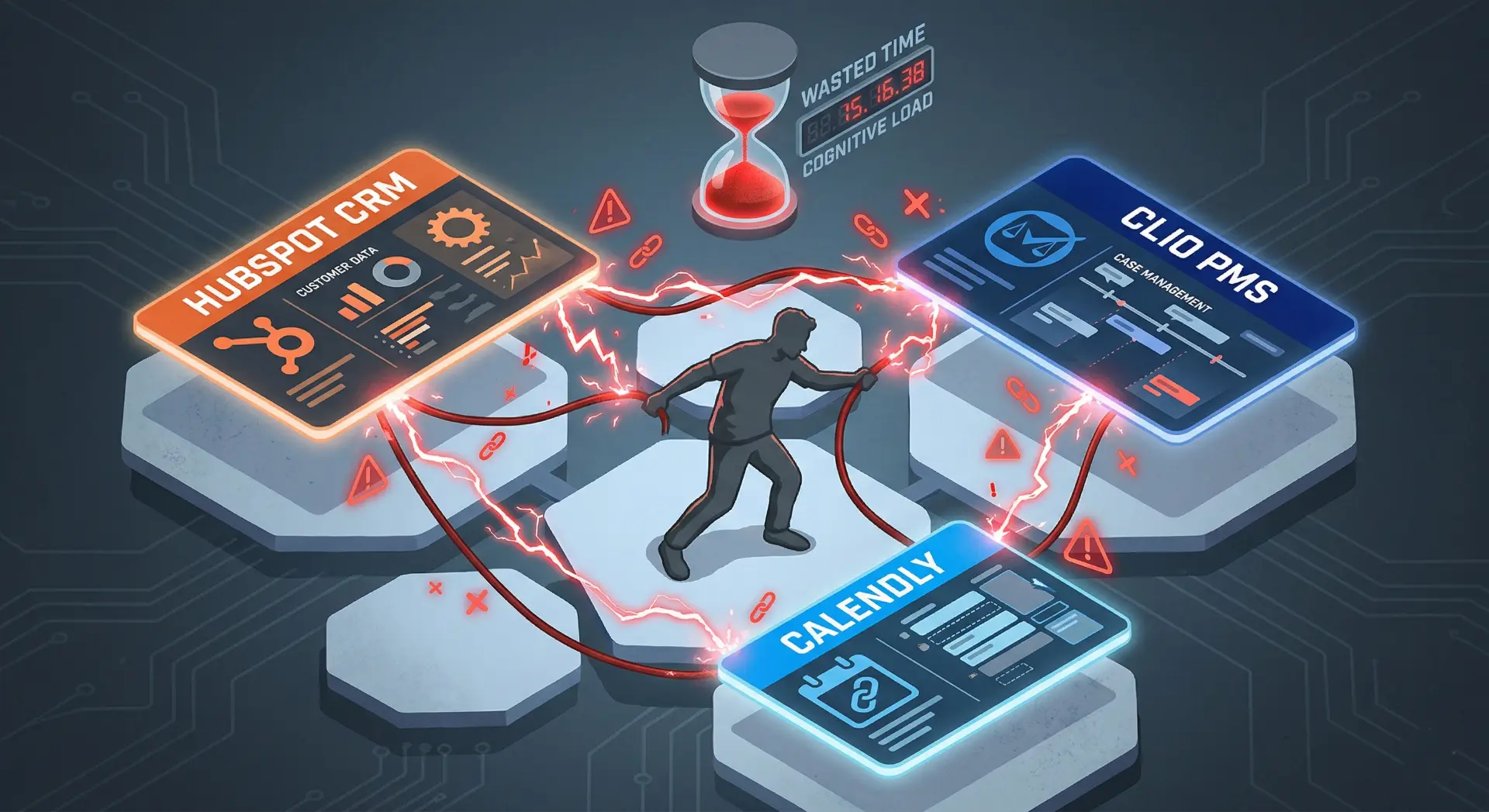
By the time that specialist picks up the phone to call the lead, they’ve spent 15 to 20 minutes on what amounts to digital janitorial work. That’s the Tab Tax: the compounded friction cost of moving data between disconnected platforms by hand. Multiply that by 20 leads a day, and you’ve consumed three or more hours of cognitive capacity on tasks a properly integrated CRM should be handling automatically.
This Is a Documented Problem, Not Just Burnout
Managing partners often hear “burnout” and assume the solution is a wellness initiative or a salary adjustment. But what most intake staff are experiencing has a more specific name: technostress.
Technostress is a well-researched psychological phenomenon documented across dozens of peer-reviewed studies. It refers to the cognitive and emotional strain caused by technology demands at work, specifically systems that are too complex, too disconnected, or too prone to failure to be trusted. Research confirms that technostress leads directly to burnout, decreased job satisfaction, and increased turnover intent.
Three specific conditions drive technostress in intake roles:
Context switching: Every time a staff member moves between a CRM, a practice management system, a VOIP tool, and a calendar platform, their brain has to re-orient to a new interface and a new set of possible failure points.
Double-entry frustration: Typing the same name and phone number into a third platform in ten minutes signals to the employee that the systems they work with don’t function properly, which erodes trust in the organization.
Low-trust systems: When automations fail silently, such as when a Zap breaks and no one catches it for three days, staff learn to double-check everything the software was supposed to handle. That vigilance is exhausting.
According to Gallup research, employees experiencing burnout are 2.6 times more likely to be actively looking for a new job. Your intake team is not immune to these dynamics.

Why Adding More Tools Usually Makes It Worse
The instinctive response to an efficiency problem is to buy an efficiency solution. Intake team is slow? Add an AI chatbot. Response time is lagging? Add an SMS tool.
Each new tool adds another login, another interface to learn, and another point of silent failure. The system gets technically larger while the actual experience of working in it gets worse. The problem is rarely the tools themselves; HubSpot and Clio are capable platforms. The problem is that they’re running in parallel rather than as a connected system, and the human beings in the middle are paying the integration tax every single day.
What a Human-Centered Intake Stack Looks Like
The goal of a properly integrated intake ecosystem is simple: the intake specialist should never have to leave their primary interface to complete a standard intake.
In a well-configured setup:
The conflict check runs automatically via API when a new contact is created and displays a status directly on the lead record.
The scheduling logic is embedded in the intake view, showing availability based on case type.
All communication (SMS, email, call notes) is logged in a single timeline on the contact record, not scattered across three inboxes.

When you remove the janitorial work, your intake specialists can give their full attention to the person who is often frightened, in pain, and deciding whether to trust your firm. That is high-touch work. It requires full cognitive presence.
The Retention Math That Should Matter to Managing Partners
Staff turnover has a real cost. Research places the total cost of replacing a mid-level employee at between 1.5 and 2 times their annual salary. For an intake specialist earning $55,000 a year, that’s an $82,000 to $110,000 replacement cost per departure.
If you’re cycling through two intake staff per year because of tool friction, the cost is a systems problem with a defined price tag. A professional CRM integration typically runs between $20,000 and $50,000. That investment pays for itself with a single retained hire. This is not a technology expense; it’s a retention strategy.
Conclusion: Look at the Browser Tabs First
When your intake team turnover rate starts rising, look at the browser tabs. If your team is spending a significant portion of every shift on manual data entry and catching automation failures, the problem is in the system, not the people.
Your best specialists want to connect with people, qualify strong cases, and represent your firm well. When the tools get out of the way, they can do that. At Wacmediya, we build and fix the CRM infrastructure that makes intake teams effective in their actual daily experience.
Ready to get the tools out of your team's way? Book a strategy session with us.
FAQ: Tech Fatigue and Law Firm Staff Retention
Is “tech fatigue” just a polite word for people not wanting to work hard? No. Technostress is a documented phenomenon. It refers specifically to the cognitive strain caused by unreliable or disconnected systems. The burnout it produces is measurable.
We already use HubSpot and Clio. Why is our team still overwhelmed? Owning the platforms is not the same as having them integrated. If your team is still switching tabs for conflict checks and manual scheduling, the integration isn’t doing its job.
How do we know if our tech stack is causing turnover versus other factors? Ask your team: “If you could eliminate one part of your daily digital workflow, what would it be?” If they point to a manual step that should be automated, you have a technostress problem.
Does fixing the CRM actually help retain staff? The research suggests that tool friction is a genuine driver of burnout. When friction is reduced, productivity and job satisfaction improve.
What is the realistic investment to fix a fragmented intake stack? At Wacmediya, the typical scope for a mid-market law firm runs between $20,000 and $50,000 depending on the volume of technical debt and required custom API work.