AI Document Tracking for Immigration Law: Stop Chasing Clients (2026)
Your immigration paralegal sent that reminder email on Monday. And Wednesday. And again on Friday. The client still hasn't uploaded their passport scan, and the I-485 filing window closes in 11 days.
This is the quiet crisis inside every high-volume immigration practice. The legal work is ready. The attorney is ready. The documents are not. And every day spent chasing a blurry scan of a birth certificate is a day your firm isn't filing, isn't billing, and isn't growing.
According to Clio's 2025 Legal Trends data, the average lawyer captures just 3.0 billable hours per 8-hour day, which is a 38% utilization rate. For immigration practitioners buried in document follow-up, that number trends even lower. And with USCIS I-130 immediate relative processing times now running 14 to 18 months in 2026, your firm cannot afford to add 30 more days of "waiting on the client" on top of that.
The immigration firms scaling in 2026 are not hiring more paralegals to nag clients. They are building Autonomous Document Pipelines that do the chasing for them, right on the client's phone, in real time.
The "Portal" Fallacy: Why Your Current System Is Failing
Most firms believe they've "automated" their document gathering because they bought a practice management system with a client portal. Docketwise, Clio, and similar platforms are excellent at storing and organizing documents once they arrive. But getting the document into that portal in the first place? That's still a manual relay race.
Here is the uncomfortable truth: clients don't log into portals. Logging in requires a remembered password, a desktop computer, and digital literacy that many immigration clients (already stressed, often navigating a language barrier) simply don't have the bandwidth for on a Tuesday night after work.

When a client gets a portal email saying "New Document Requested," they ignore it. When they get a WhatsApp or SMS message with a direct upload link, they act. This is not a theory: SMS open rates run north of 95%, compared to roughly 20 to 25% for email.
That gap is not a design problem. It is an architecture problem. And the fix is not a better portal; it is a completely different kind of pipeline.
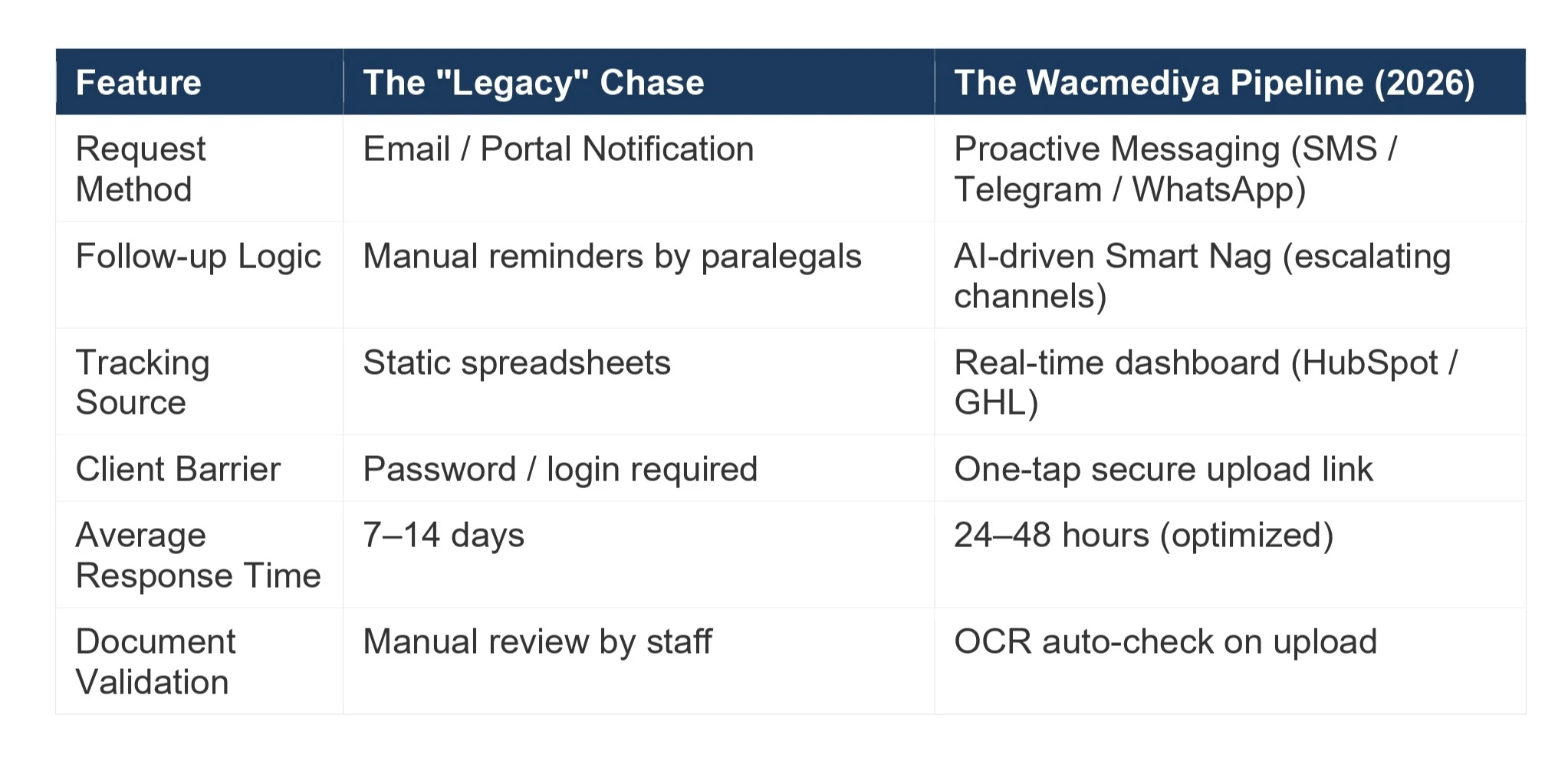
Comparison: Manual Chasing vs. Autonomous Document Pipelines (2026)
The Missing Workflow: Google Apps Script + Proactive Messaging
The Wacmediya approach to immigration document management moves the friction from the client to the system. We've built and productized a workflow that most firms are missing: a Google Apps Script + CRM + Proactive Messaging tracker. Here's how it works in practice:
Step 1: The "Evidence Checklist" Trigger
The moment a new case is opened in your CRM (HubSpot, GoHighLevel, or a similar platform), the system automatically generates a dynamic Evidence Checklist specific to that visa type. An H-1B petition has a different checklist from an O-1 or an asylum case. Each item (passport, I-94, employment offer letter, proof of funds) is created as a living data record with a status of Pending.
Step 2: The Messaging Bridge
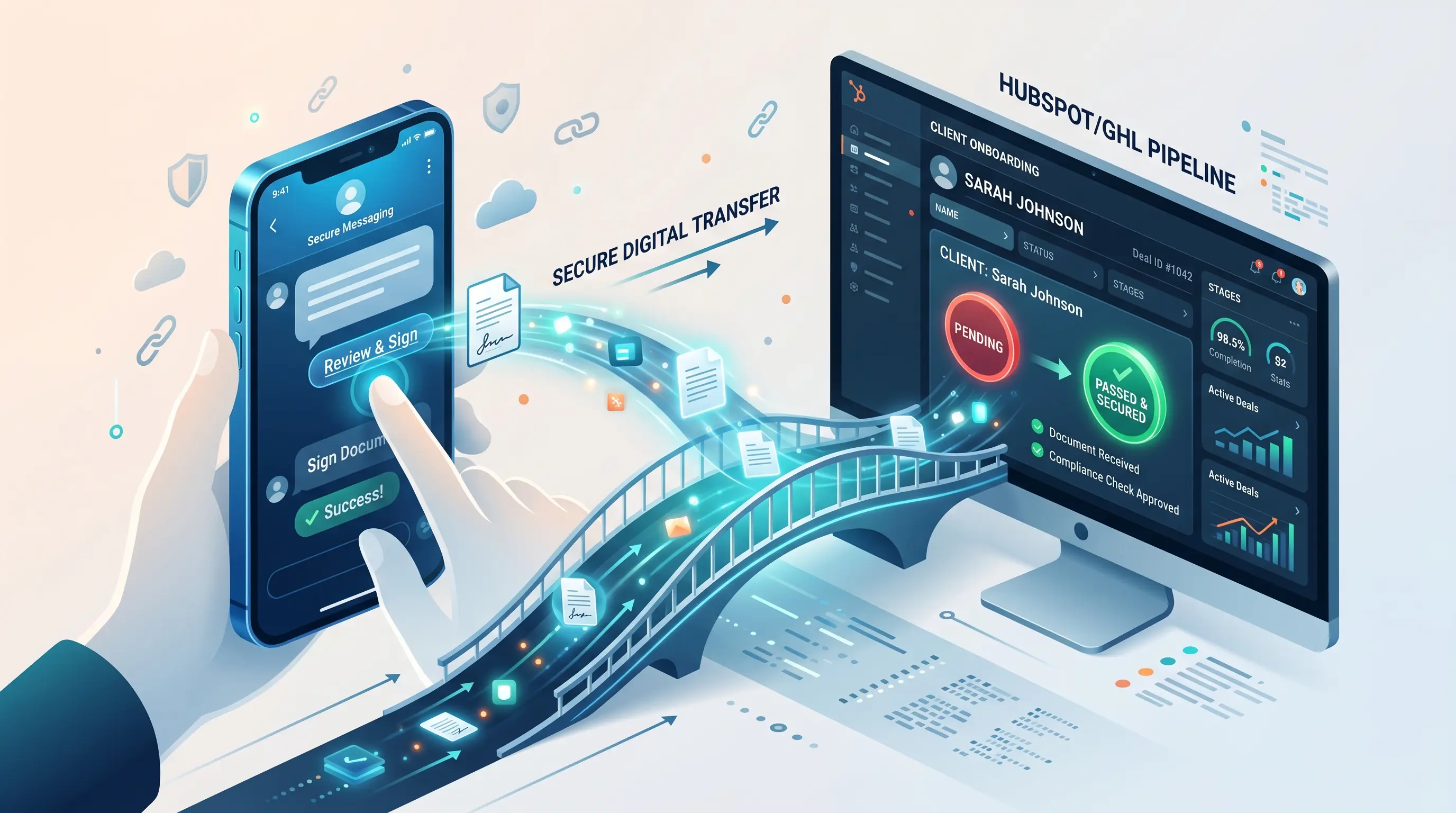
Instead of sending a bulk email to an inbox nobody checks, the system fires a personalized, sequenced message via SMS, WhatsApp, or Telegram. The message contains a unique, time-stamped secure upload link. The client clicks it, photographs the document with their phone, and uploads it in under 60 seconds with no portal account required.
This isn't just a convenience feature; it is a compliance infrastructure. Because that upload link routes directly into your CRM, every document is automatically tagged, timestamped, and mapped to the correct case file without a single manual entry by your staff.
Step 3: The Autonomous "Smart Nag" Loop
This is where the chasing stops being a human task. If the Passport status remains Pending after 48 hours, the system fires a polite reminder. After 96 hours, it escalates with a different message tone or a switch to a different channel. Your paralegal only receives a notification when the client has failed to respond after three automated attempts.
The Real Cost of Document Friction: Running the Numbers
In 2026, USCIS continues to manage a record backlog across all form types. For immediate relatives of U.S. citizens, I-130 processing via consular pathway now averages approximately 14 to 15 months, with family preference categories stretching to years. When your firm adds 30 days of internal document delay on top of that, you are not just frustrating a client. You are potentially pushing them past a priority date or forcing an emergency filing.
Consider the labor math for a mid-sized firm running 200 active cases:
200 cases × 15 minutes/week per case in follow-up = 50 hours per week
At a $30/hr paralegal rate, that is $1,500 per week in administrative chasing
Annualized, that means approximately $78,000 per year in "document janitorial work"
That $78,000 is not going toward case strategy, client communications, or filing more petitions. It is going toward emails that get ignored. Automating the chase does not just save money; it recovers capacity.
The Part Nobody Talks About: Document Validation in 2026
Even when clients do respond quickly, the document they send is often wrong. "IMG_0402.jpg" via WhatsApp. A blurry PDF of the wrong year's tax return. A birth certificate in place of a passport. These errors are invisible until a paralegal opens the file, at which point the clock resets.
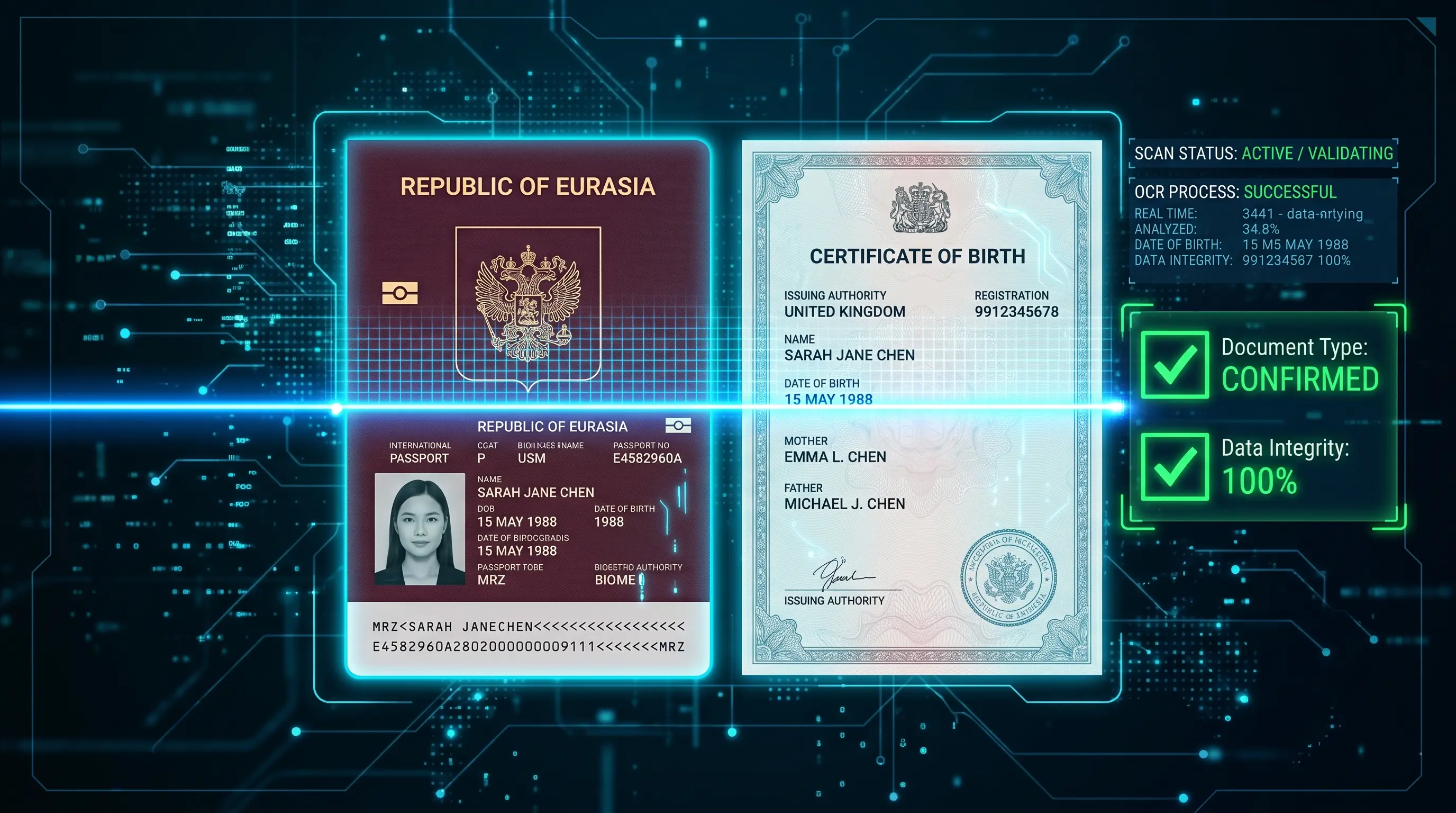
A properly built pipeline doesn't just receive files. It validates them. OCR-based document recognition can identify whether the uploaded file matches the requested document type (even for foreign-language documents like a Mexican birth certificate or an Indian passport) and immediately prompt the client for a re-upload if it doesn't match. Your staff never has to touch the mistake.
This is the data integrity layer that most document management conversations skip. When you are working against a 14-month USCIS processing timeline, a two-day OCR catch is the difference between a clean filing and a Request for Evidence adding another 60 days to the case.
The 2026 Factor: Why This Is More Urgent Than Ever
The immigration landscape in 2026 has introduced new layers of uncertainty for law firms and their clients. USCIS Policy Memorandum PM-602-0194, effective January 2026, introduced adjudication holds for nationals of certain designated countries, adding unpredictability on top of already strained processing timelines. USCIS fee increases (effective March 2026) have also raised the cost of errors: a Request for Evidence or a rejected filing now carries a higher financial and timeline penalty than ever.
In this environment, a firm that is still manually chasing documents is not just inefficient; it is a liability. One missed upload, one delayed filing, or one overlooked priority date can result in a case that is both legally and financially costly to recover.
Building proactive document infrastructure is no longer a nice-to-have for immigration firms. In 2026, it is a competitive baseline.
Conclusion: Stop Chasing. Start Filing.
Your firm's value is not measured by how persistently you follow up with clients. It is measured by how consistently you file clean, complete, and timely petitions, and how well you protect your clients' legal status in a system that has very little margin for administrative error.
An immigration firm with a disconnected tech stack (case management in one silo, document requests in another, follow-up in a paralegal's inbox) is running a manual relay race in a system that has no patience for dropped batons.
At Wacmediya, we build the proactive document infrastructure that immigration firms need to scale without adding headcount. Our Google Apps Script + CRM + Messaging pipelines integrate directly with your existing HubSpot or GoHighLevel setup, replacing the manual chase with a zero-touch gathering system that keeps your team focused on the law.
If your firm is still spending 50+ hours a week on document follow-up, a pipeline audit is the right next step. Let's look at where the friction is and close it permanently.
FAQ: Immigration Document Automation
Is it secure to send document upload links via SMS or WhatsApp?
Yes, provided the link leads to a SOC 2-compliant secure upload portal. The messaging app is simply the delivery vehicle; the client's data is encrypted in transit and at rest, and it is never stored on the messaging platform's servers. The upload portal itself generates a unique, time-limited token for each request, so links cannot be reused or shared.
What if a client doesn't use Telegram or WhatsApp?
The pipeline is channel-agnostic by design. We configure the system to prioritize the client's preferred channel (SMS, WhatsApp, Telegram, or even email) while maintaining the same automated tracking logic on the backend. The CRM records every interaction regardless of which channel the client responds on.
Does this replace my practice management system like Docketwise or Clio?
No, it extends it. Practice management systems are excellent filing cabinets: they store and organize what's already inside. Our pipeline is the conveyor belt that gets documents into the cabinet without your team having to carry them individually. The two work better together than either works alone.
Can the OCR layer handle foreign-language documents?
Yes. Modern OCR engines identify document type and country of origin even when the text is in a foreign language. A Mexican CURP card, an Indian passport, or a Brazilian birth certificate can each be mapped to the correct checklist field. The system flags anything it cannot confidently classify for human review, keeping your team's time focused on exceptions.
How does this improve our USCIS filing speed specifically?
The most common preventable source of delay is the "gathering phase," which covers the weeks between case open and having all documents in hand. By collapsing gathering from weeks to days, your team reaches the drafting phase faster, files closer to the priority date, and reduces the risk of a Request for Evidence caused by a missing or incorrect document.