
Scaling Immigration Law: Manage High Volume Without Hiring (2026)
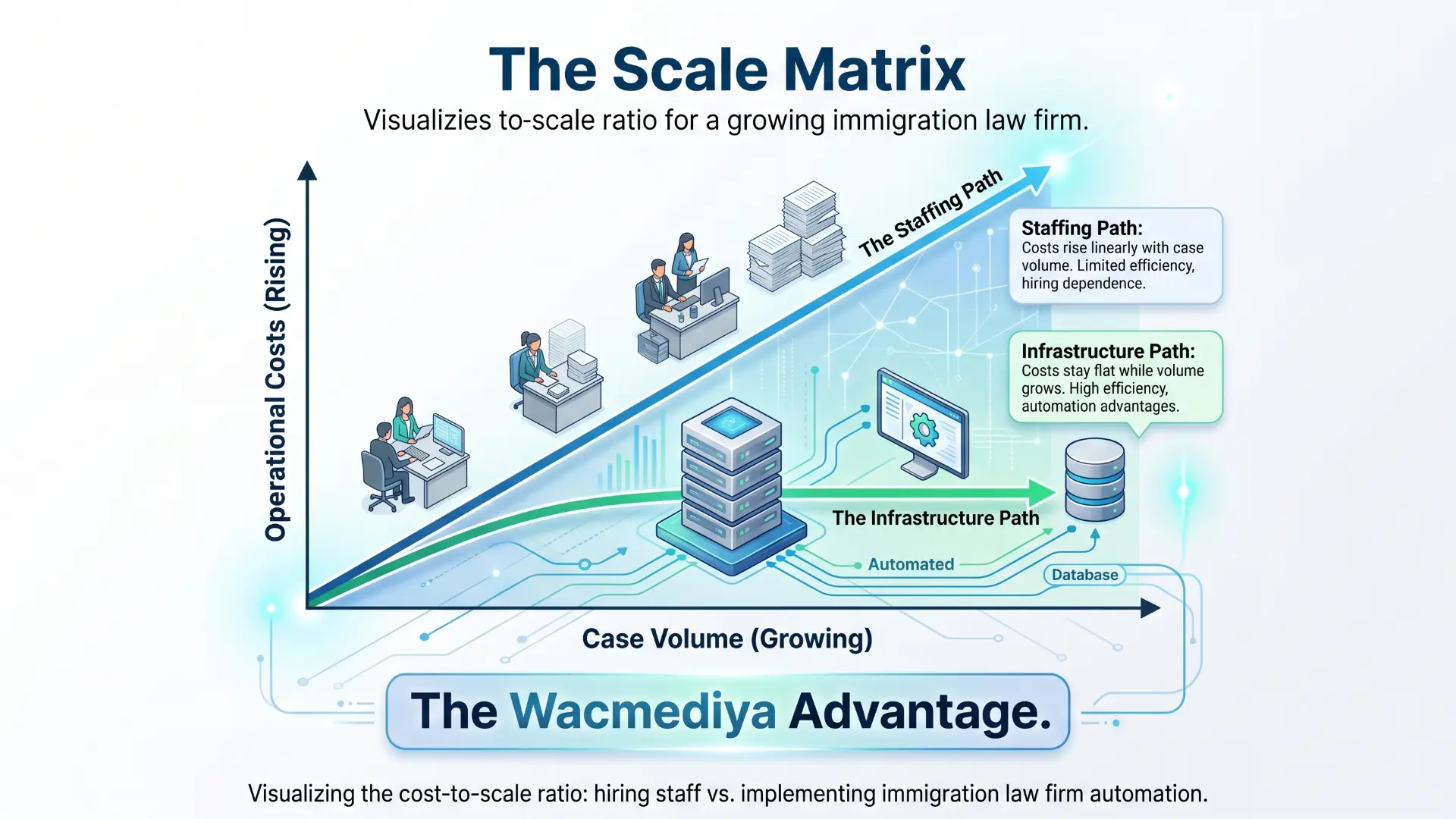
Your immigration firm is drowning and your instinct is probably to hire your way out of it. Following the wave of policy shifts in late 2025, demand for immigration filings has hit levels most firms weren't staffed to handle. H-1B petitions, family-based I-130s, asylum cases the caseload keeps growing. Your paralegals are working 60-hour weeks. Deadlines are stacking up. And a new hire sounds like relief.
But here is the harder truth: adding people to a fragmented system doesn't fix the system. It adds communication overhead, training lag, and new points of failure. You aren't patching the hole you're bailing out the boat with a bigger cup.
The immigration firms actually scaling in 2026 are not the ones with the most staff. They are the ones that replaced their manual relay race with an infrastructure that runs on its own.
The Hiring Trap: Why Adding Staff Compounds the Problem
According to Clio's 2025 legal industry benchmarks, the average lawyer captures just 3.0 billable hours out of every 8-hour workday a 38% utilization rate. The rest disappears into administrative work: chasing documents, updating status fields, fielding client inquiry calls, and coordinating internally.
Now think about what happens when you bring on a new paralegal. You are not getting 40 hours of clean legal work per week. Based on that same utilization pattern, you are getting roughly 20 hours of productive case work and 20 hours of what every immigration firm knows well: administrative overhead. Plus the time you spend managing, training, and onboarding that new person.
The BLS median salary for a paralegal is $61,010 as of 2025, and Glassdoor's 2026 data puts the average closer to $64,076. Add benefits, onboarding, and the management time absorbed by a new hire, and the real cost of that decision lands between $75,000 and $90,000 per year for a capacity gain that stays vulnerable to the same bottlenecks the whole firm is already struggling with.
The goal in 2026 is not more people. The goal is a higher case-to-human ratio the same team handling meaningfully more volume, because the infrastructure is doing the work that shouldn't require a human in the first place.
The 2026 Scale Strategy: Three Automation Pillars
Moving from a people-powered firm to an infrastructure-powered firm requires three specific shifts. Each one targets a different category of lost time.
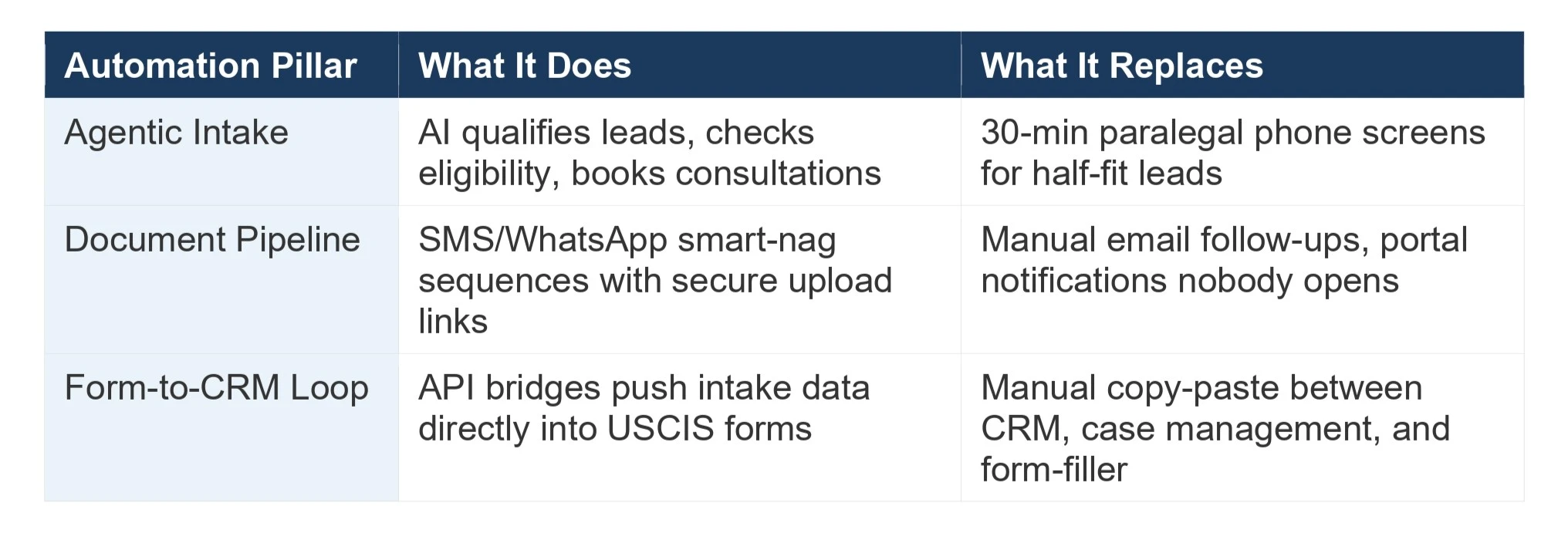
Pillar 1 Agentic Intake: Qualify Leads Before Your Staff Touches Them
Most immigration firms lose significant hours in the qualification phase. A lead calls or submits a form, a paralegal spends 25-30 minutes walking through eligibility questions, and in many cases the lead isn't a fit for the firm at all.
An agentic intake system built on your firm's specific knowledge base your practice areas, your visa categories, your screening criteria can handle the first stage of qualification automatically. It asks the right intake questions, maps the responses against current USCIS eligibility requirements, and surfaces only qualified, appointment-ready leads to your team. Your staff's first interaction with a new client is a booked consultation, not a cold screening call.
Important note on scope: agentic AI assists with structured qualification and routing. Legal strategy, case assessment, and advice still belong with your attorneys. The system handles the logistics so your team can focus on the law.
Pillar 2 Proactive Document Pipeline: Collapse the Gathering Phase
Document gathering is the single largest controllable bottleneck in immigration. As we covered in our [AI Document Tracking Guide link to: /blog/immigration-law-firm-document-management-automation], firms relying on portal notifications and email reminders are operating at a structural disadvantage.
A messaging-first pipeline sequenced SMS and WhatsApp requests with one-tap secure upload links and automated escalation logic collapses the evidence-gathering phase from weeks to days. The system does the follow-up. Your paralegal only gets involved when a client has missed three automated touchpoints. That shift alone allows one paralegal to manage a substantially larger caseload without the burnout that drives turnover.
Pillar 3 The Form-to-CRM Loop: Eliminate Manual Double-Entry
A disconnected firm has client data in a CRM, case data in a practice management tool like Docketwise or Clio, and petition data in a form-filler. Moving information between these three systems manually is where typos enter petitions and typos in immigration filings cost time, money, and client trust.
A unified stack uses API bridges so that data entered at intake flows directly into the correct fields of the appropriate USCIS form. No re-typing of alien registration numbers, no copy-pasting addresses, no mismatched dates between a HubSpot record and a Docketwise petition. When USCIS issues a Request for Evidence, it is usually because of a documentation gap or a detail error both of which are preventable with a properly connected data layer.
The USCIS Backlog Burden: Why Client Management Is Now Its Own Problem
USCIS closed Fiscal Year 2025 with nearly 12 million pending cases the largest backlog in the agency's history. Standard I-140 processing times for employment-based categories run between 4.5 and 22.5 months depending on visa type and service center. EB-2 NIW cases are seeing timelines of 8-20+ months at some centers. For H-1B (I-129), standard processing runs 3-6 months; I-130 immediate relatives are averaging 14-15 months via consular processing.
These timelines mean your firm is in an extended holding pattern on every active case. And clients do not sit quietly in a holding pattern. They call for updates.
The Status Inquiry Math
50 status inquiry calls per day × 5 minutes each = 4.1 hours of staff time, every day
Across a 5-day week: over 20 hours of non-billable client management
Annualized: more than 1,000 hours of staff time spent on calls that convey no new information
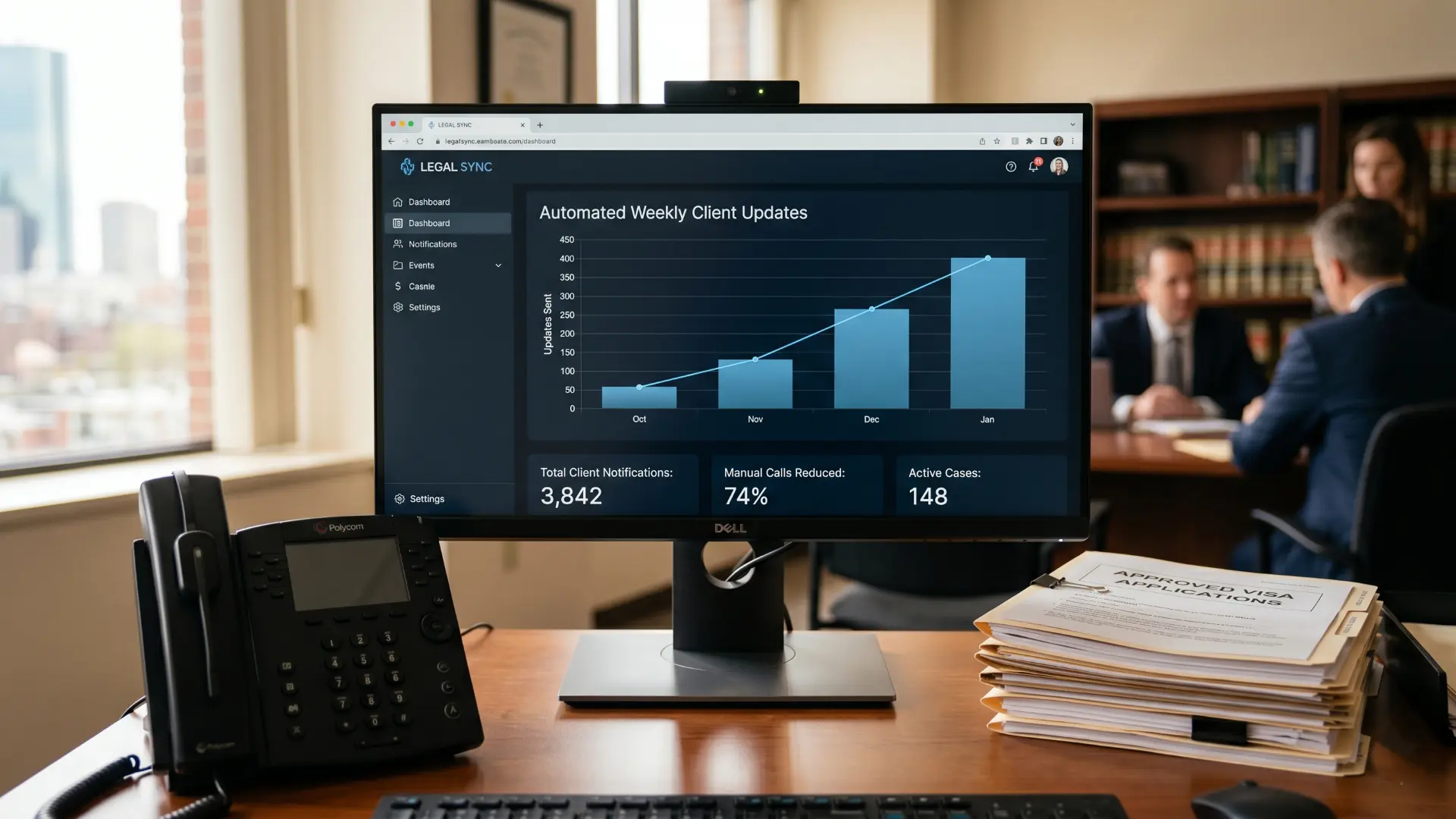
An API-linked status system solves this with a weekly automated update sent directly to each client case status, pending items, estimated next milestone. Your staff handles the exceptions, not the routine. That 20+ hours per week becomes recoverable capacity, immediately.
The Cognitive Load Factor: Why High Volume Breaks People, Not Just Systems
Managing 30 immigration cases is a memory game. Managing 150 is a systems game. When volume spikes beyond what a person can hold in their head, error rates climb with it a missed deadline, a document filed in the wrong matter, an overlooked policy update from USCIS. These are not individual failures. They are what happens when you scale people beyond the system's architecture.
Automation lowers the cognitive load by externalizing the routine: reminders, status checks, document validation, and intake routing all happen inside the system rather than inside someone's head. Your attorneys and paralegals stay focused on the work that requires legal judgment because the work that doesn't require legal judgment is already handled.
This is also the retention argument. The paralegals leaving their firms in 2026 are not leaving over salary. According to AILA and various legal HR surveys, they are leaving over tech fatigue the daily grind of toggling between disconnected systems, re-entering the same data, and managing the same recurring follow-ups with no relief in sight.
The 2026 Factor: The Environment Has Changed
Several 2025-2026 developments have made the case for infrastructure even more urgent:
USCIS ended automatic EAD extensions in October 2025, meaning I-765 renewal timing is now critical gaps in work authorization are immediate, not theoretical
USCIS fee increases effective March 2026 raised premium processing costs to $2,965 for I-129/I-140 filing errors are now more expensive to correct than ever
Policy Memorandum PM-602-0194 (January 2026) introduced adjudication holds for nationals from designated countries, adding new status tracking complexity for affected cases
The H-1B now carries a $100,000 Presidential Proclamation fee for new initial petitions filed after September 2025 sponsors are more selective, and case preparation quality is under greater scrutiny
Each of these changes increases the penalty for administrative errors and the value of a clean, well-organized case file. A firm still running on disconnected systems and manual follow-up is operating on a margin that no longer exists.
Conclusion: Infrastructure Is Your Only Real Moat
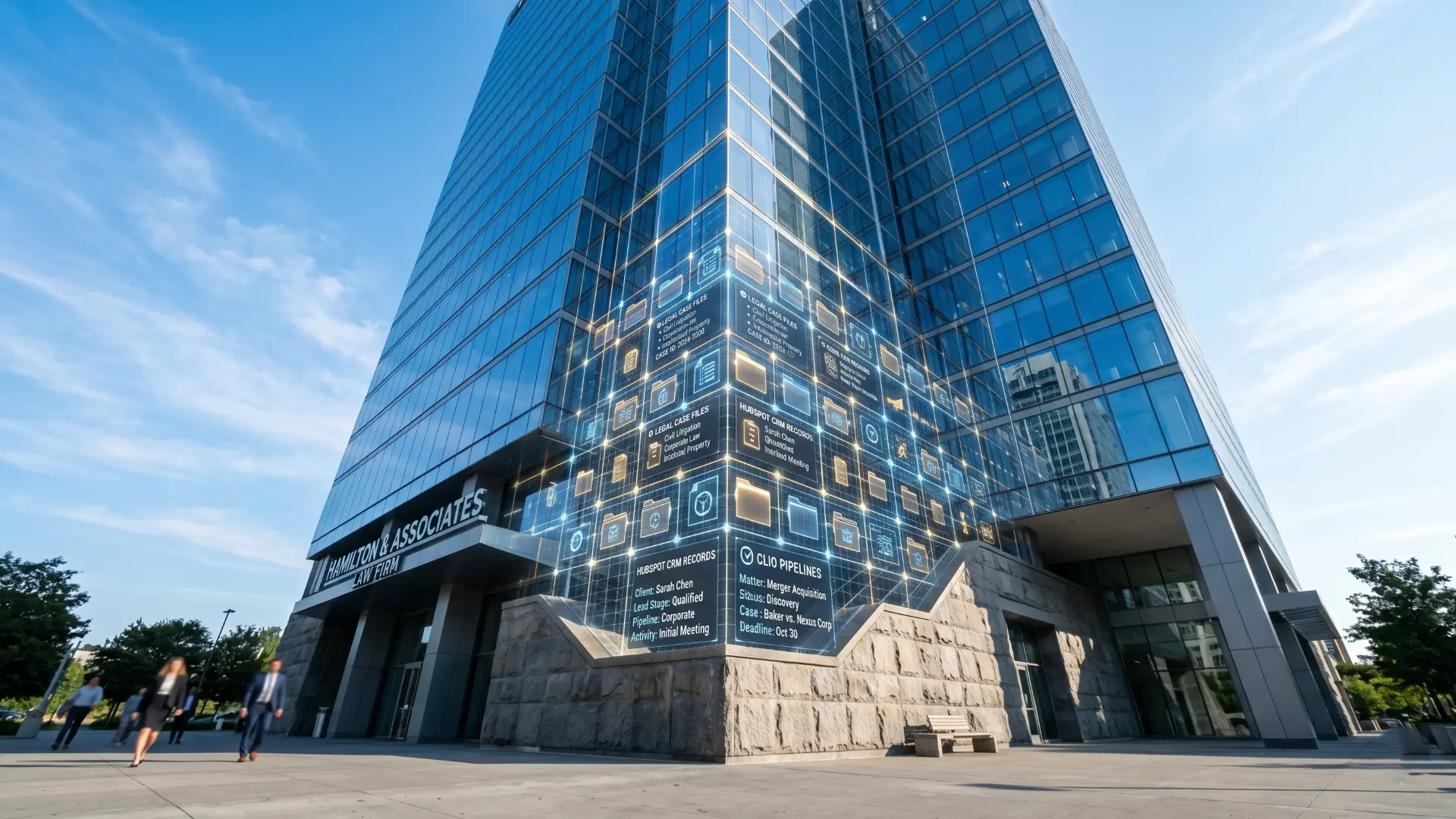
In 2026, every immigration firm has access to the same laws, the same USCIS forms, and the same visa categories. The only sustainable competitive advantage is operational how quickly you move a case from open to filed, how cleanly your data flows from intake to petition, and how reliably your clients are kept informed without your staff spending 20 hours a week on status calls.
At Wacmediya, we build the infrastructure layer that immigration firms need to scale without proportionally expanding headcount. Our work spans HubSpot and GoHighLevel CRM architecture, Google Apps Script automation, Docketwise and Clio API integrations, and proactive messaging pipelines that replace the manual chase entirely.
If your firm is operating on duct tape data in three systems, follow-up by email, status updates by phone call an infrastructure audit is the right place to start. We map your current lead-to-matter flow, identify where time and data are leaking, and build a clean foundation before adding any automation layer on top.
FAQ: Scaling Immigration Practices Through Automation
How can AI handle the nuance of 2026 immigration policy changes?
Agentic AI systems are grounded in a knowledge base that you control your firm's practice areas, current USCIS policy memos, and your internal qualification criteria. Unlike rigid scripted bots, they reason across this knowledge to route and qualify cases. The key distinction: AI handles structured qualification and logistics. Legal strategy and case assessment remain with your attorneys. The system is a routing and triage layer, not a legal advisor.
Is building a unified tech stack affordable for a smaller immigration firm?
When measured against the full cost of a new hire median salary of $61,000-$64,000, plus benefits, onboarding, and management time totaling $75,000-$90,000 annually a professional CRM build and automation layer is typically a fraction of that cost as a one-time investment. The difference is that infrastructure scales without requiring another annual budget line every time caseload grows.
Which CRM setup works best for scaling immigration practices?
We find that HubSpot or GoHighLevel, integrated with a legal-specific matter management tool like Clio or Docketwise, gives immigration firms the best balance of marketing and operational depth. HubSpot's pipeline and automation features handle intake and client communication well; Clio or Docketwise manages the legal matter and form side. API bridges between the two eliminate the double-entry problem entirely.
Will our staff actually use new systems, or will this create more resistance?
Staff resist systems that create more work more tabs, more logins, more manual steps. They embrace systems that remove the tasks they dislike most: repeating the same follow-up emails, updating the same fields across multiple platforms, fielding the same status inquiry calls. The rollout approach matters: start with the automations that visibly remove pain points, and adoption follows.
Our data is a mess. Where do we start?
You start with an infrastructure audit before you add any automation. We map your current lead-to-matter flow, identify every point where data is entered manually or re-entered across systems, and build a clean data foundation first. Automation layered on top of a messy data architecture just moves errors faster. A clean foundation is the prerequisite.