GoHighLevel for Personal Injury Law Firms: Setup Guide (2026)
A potential client fills out your website form at 7:30 PM, right after a car accident. Your office is closed. The form lands in an inbox. By 9:15 AM the next morning, when your paralegal gets to it, that person has already signed with a competing firm that replied within five minutes.
This is not a hypothetical. It is the standard intake failure pattern we see at personal injury firms across the US. And it is exactly the problem GoHighLevel (GHL) was built to solve.
This guide explains how personal injury law firms can use GoHighLevel to close that gap from the moment a lead touches your website to the moment they sign a retainer. We cover the PI-specific workflow setup, what GHL does well, where it has limits, and how it fits alongside legal software like Clio.
Why PI Firms Are Uniquely Vulnerable to Slow Follow-Up
Personal injury practice has a characteristic that most other legal verticals do not: prospects are shopping multiple firms at once, often within minutes of an incident. Research published by InsideSales.com found that sales teams who respond within five minutes are eight times more likely to reach a prospect than those who wait thirty minutes. In legal services, that window is arguably shorter.
The average law firm, however, takes 2-3 business days to follow up on a web form submission, according to a widely cited legal intake audit. At a PI firm running Google Ads, Local Services Ads, or a high-traffic website, that delay translates directly to lost cases, not lost inquiries, lost cases.
GoHighLevel does not change your lawyers. It changes what happens in the two minutes after a lead submits a form or misses a call.
What GoHighLevel Actually Is (and Isn't) for a PI Firm
Before configuring anything, understand where GHL fits in your tech stack.
GHL handles the marketing and intake layer: lead capture, instant response, consultation scheduling, follow-up sequences, referral tracking, and post-matter review requests. It is the system that works between "stranger finds your firm" and "client signs retainer."
GHL does not replace your practice management software. Tools like Clio, MyCase, or CASEpeer handle billing, matter management, document storage, trust accounting, and court calendaring. Those stay. GHL sits in front of them.
Many PI firms we work with run GHL alongside Clio, GHL handles acquisition, Clio handles the active matter. Once a retainer is signed, the contact moves from GHL into Clio. That separation keeps each tool doing what it does best.
The Personal Injury Intake Workflow in GoHighLevel
Here is how a properly configured GHL setup handles a PI lead from first touch to booked consultation.
Step 1: Lead Capture and Instant Response
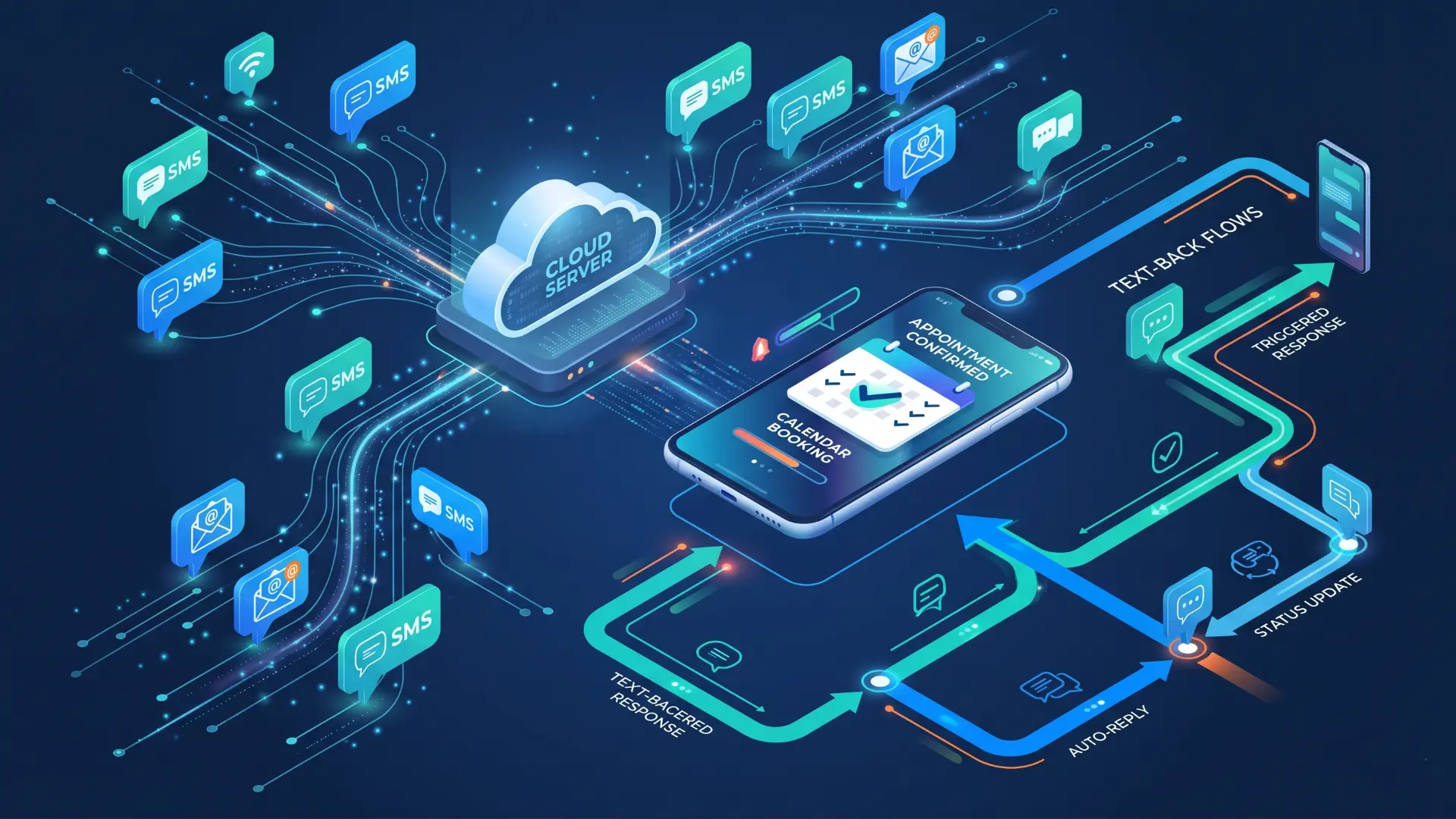
A prospect clicks a Google Ad for "car accident attorney," fills out a short intake form, and hits submit. Within seconds, GHL fires two automated messages:
SMS: "Thank you for reaching out to [Firm Name]. We received your message and an attorney will review your case shortly. Would you like to schedule a free consultation now?" with a direct booking link attached.
Email: A branded confirmation with the same booking link and a brief overview of what to expect next.
This happens at any hour, including 2 AM on a Saturday. No paralegal involvement required for the first response.
Step 2: Practice Area Tagging and Case-Type Routing
This is where most generic GHL setups fail PI firms and where a proper implementation pays for itself.
Personal injury is not one practice area. A firm handling motor vehicle accidents, slip-and-falls, medical malpractice, and workers' compensation needs different intake questions, different qualifying criteria, and different attorneys assigned per case type.
In GHL, this is solved with conditional form logic and workflow branching:
A prospect who selects "car accident" gets tagged
PI – MVAand routed to the auto injury intake sequenceA prospect who selects "slip and fall" gets tagged
PI – Premiseswith different qualifying questions (location, property type, incident date)A prospect who selects "medical malpractice" gets routed to a separate qualification step, since these cases require a higher intake bar before consultation is offered
Each tag triggers its own follow-up sequence, assigns the lead to the right team member, and moves it into the correct pipeline stage. Without this routing, your intake team is manually sorting and reassigning every inbound lead which introduces delay and errors.
Step 3: Consultation Booking Without Back-and-Forth
The first follow-up message includes a calendar link connected directly to the attorney's or intake coordinator's availability in GHL. The prospect self-schedules. GHL sends a confirmation, plus automated reminders at 24 hours and 2 hours before the appointment.
No-show rate drops significantly when reminders fire automatically. And if a prospect does not book within the first message, the nurture sequence takes over.
Step 4: The Nurture Sequence for Non-Bookers
Not every PI lead books on the first contact. Some people submit a form, get distracted, and forget. A properly built GHL sequence re-engages them over 7–14 days without any manual effort:
Day 1: SMS with booking link
Day 2: Email with a brief FAQ about the PI process
Day 4: SMS check-in ("We want to make sure your questions are answered, are you still looking for representation?")
Day 7: Final outreach with a soft close
If the prospect books at any point, the sequence stops. If they opt out, GHL marks them inactive. Every touchpoint is logged in the contact record for compliance purposes.
Step 5: Post-Consultation Pipeline Movement
After the consultation, the lead moves to one of three stages in your GHL pipeline:
Retainer Sent, follow-up sequence fires to prompt signing
Signed, record is transferred to Clio or your case management system
Did Not Qualify, tagged appropriately, removed from active sequences, optionally added to a long-term nurture list for referrals
The visual pipeline gives your intake team a clear view of every prospect at every stage without digging through emails or spreadsheets.
Four GHL Features Every PI Firm Should Configure
1. Missed Call Text-Back
When a prospect calls your office and nobody answers, GHL immediately sends an automated SMS: "We missed your call at [Firm Name]. We want to help, reply here or book a free consultation at [Link]"
This single feature recovers a significant portion of after-hours leads that would otherwise go unanswered. For a PI firm running paid advertising, where every call costs real money, missed call text-back pays for itself quickly.

2. Voice AI for After-Hours Calls
For firms with higher call volume, GHL's Voice AI (we deploy this using Retell AI for more flexible configuration) answers after-hours calls, asks qualifying questions, and delivers a transcript and summary to the on-call attorney or intake coordinator via SMS, typically within minutes of the call ending. The prospect gets an immediate response; the attorney gets actionable information before 9 AM.
3. Referral Source Tracking
PI firms often run multiple lead sources simultaneously: Google Ads, Local Services Ads, organic SEO, referral attorneys, settlement funding partners. GHL's pipeline tracks which source each lead came from, which source produces the most signed retainers, and which source produces the highest case values. This data directly informs where to increase or pull back marketing spend.
4. Post-Matter Review Request Sequence
After a case closes, GHL automatically sends a two-step review request sequence to the former client, first by SMS, then by email, directing them to your Google Business Profile. Google reviews for PI firms directly affect local search rankings and new client trust. Running this manually is inconsistent; running it through GHL makes it standard procedure on every closed matter.
GoHighLevel vs. Clio vs. Lawmatics: The Honest Comparison
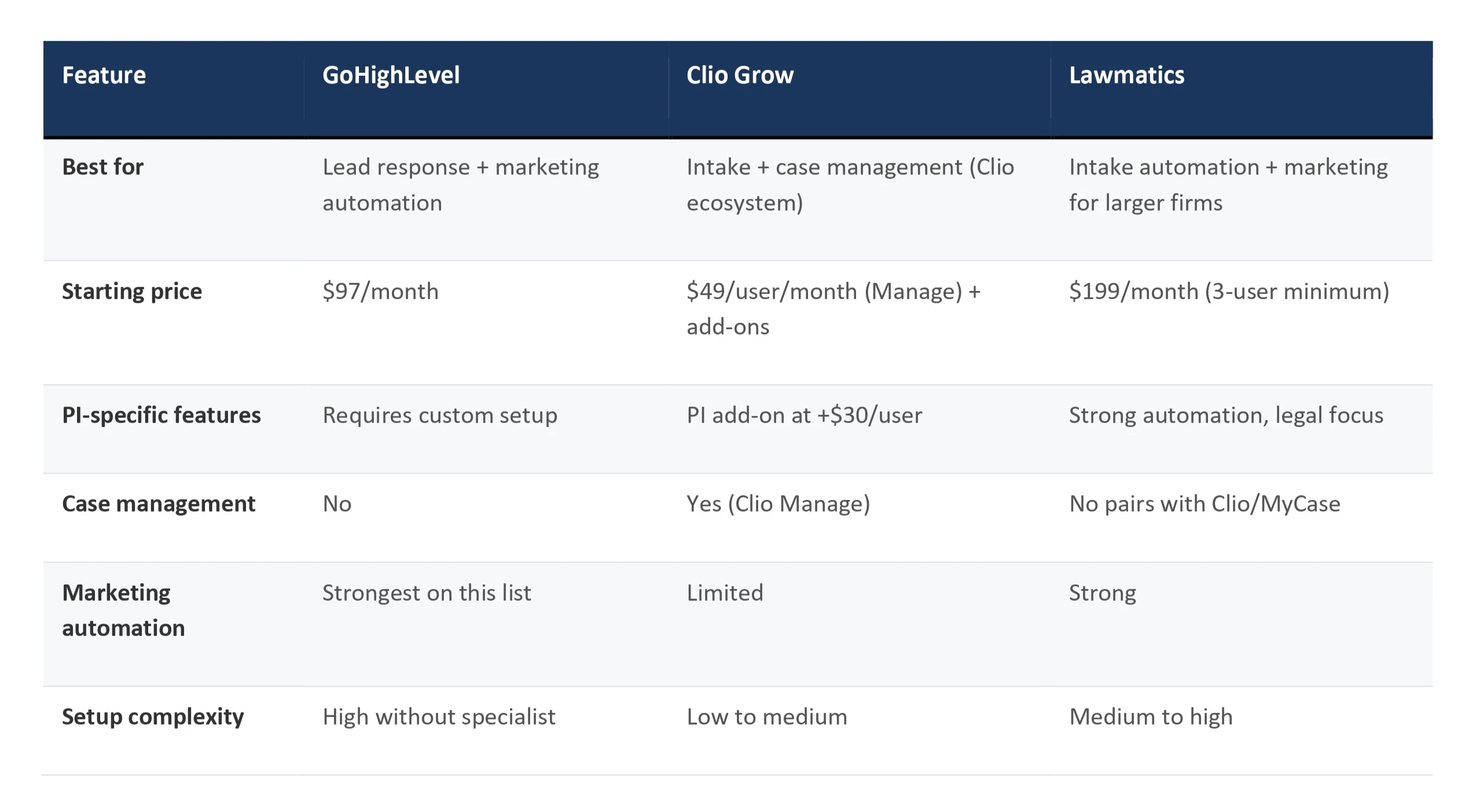
The key takeaway: GHL is not a Clio replacement, and Clio is not a GHL replacement. They solve different problems. Solo attorneys and small PI firms without an existing case management investment often find GHL the most practical starting point because it covers intake, marketing, and basic CRM in one subscription. Firms already on Clio typically add GHL on top to handle the marketing layer Clio does not cover.
What to Know Before You Set It Up
A2P 10DLC Registration Before sending bulk SMS through GHL in the United States, your business must be registered for A2P 10DLC through GHL's Phone Settings → Trust Center. Unregistered SMS campaigns face filtering and delivery failures. This is a non-negotiable setup step, not an optional extra.
State Bar Advertising Rules Automated attorney communications are subject to your state bar's advertising rules. Requirements vary by jurisdiction. Keep automated messages confined to scheduling and intake logistics, not legal advice, case assessments, or outcome representations. Include your firm name and an opt-out option in every automated sequence.
GHL Requires Proper Implementation GoHighLevel is a flexible platform, not a pre-configured legal tool. The intake routing, pipeline structure, case-type tags, and nurture sequences described in this guide require deliberate setup. Out of the box, GHL is a blank canvas. Firms that deploy it without a structured implementation plan typically underuse it and conclude it does not work when the platform was never properly configured for their workflow.
Is GoHighLevel Right for Your Personal Injury Firm?
GHL is a strong fit if your firm:
Runs active marketing (Google Ads, LSAs, SEO, or referral campaigns)
Has at least one staff member who manages leads and intake
Is losing leads to slow follow-up or after-hours gaps
Wants to consolidate multiple tools (email, SMS, scheduling, pipeline) into one subscription
GHL is a weaker fit if your firm:
Operates entirely on referrals with no marketing activity
Needs HIPAA-compliant document storage or trust accounting (use Clio or CASEpeer for those)
Expects a plug-and-play solution without any configuration investment
Frequently Asked Questions
Does GoHighLevel work for solo PI attorneys? Yes. Solo attorneys often see the most immediate impact because GHL replaces tasks that would otherwise require a full-time intake coordinator, instant lead response, appointment reminders, and follow-up sequences run automatically without staff involvement.
Is GoHighLevel HIPAA compliant for law firms? GoHighLevel does support HIPAA compliance, but it comes as a paid add-on at $297/month on top of your existing plan. It is not tier-restricted, any GHL subscriber can add it. If your firm handles protected health information, factor that additional cost into your decision.
Can GoHighLevel replace Clio for a PI firm? No. GHL handles the marketing and intake layer, lead response, follow-up, and consultation scheduling. Clio handles active matter management, billing, document storage, and trust accounting. Most PI firms benefit from running both.
How long does it take to set up GoHighLevel for a PI firm? A basic setup covering instant lead response, consultation booking, and follow-up sequences can be live in 3-7 days. A full implementation, including case-type routing, multi-source pipeline tracking, Voice AI, and Clio integration, typically takes 2–6 weeks depending on firm complexity.
What does GoHighLevel cost for a law firm? GoHighLevel's Starter plan is $97/month and includes unlimited contacts and users, with support for up to 3 sub-accounts. The Unlimited plan at $297/month adds unlimited sub-accounts and a branded desktop app useful for firms with multiple office locations. A SaaS Pro plan at $497/month exists for agencies reselling GHL to clients, which is not relevant for a direct law firm. None of the plans include setup or configuration that requires working with an implementation partner or a significant internal time investment.
Conclusion
Personal injury is one of the most competitive legal verticals in the United States. Cases go to the firm that responds first, follows up consistently, and removes friction from the intake process. GoHighLevel, when properly configured for PI-specific workflows, addresses all three.
It will not manage your cases, handle your billing, or replace Clio. But it will make sure that every lead who contacts your firm at 11 PM gets a reply within sixty seconds and that the ones who do not book immediately get followed up with automatically until they do.
If you are running a PI firm and want to understand whether GHL is the right move for your current setup, we are happy to walk through it.
Wacmediya Global IT Services specializes in GHL implementation for US personal injury and immigration law firms. We build intake systems, case-type pipelines, and marketing automation stacks, configured for how law firms actually work.