Agentic AI for Law Firm Intake: Beyond Chatbots in 2026
Your chatbot is doing its job. It’s capturing names, email addresses, and the basic facts of a potential client’s situation. And then it hands that data to a human who reads the transcript, checks for conflicts, verifies the jurisdiction, and plays phone tag to book a consultation.
That human is the bottleneck. In 2026, the best-performing law firms are eliminating it.
The industry is in the middle of a shift from generative AI (tools that write things) to agentic AI (systems that do things). For personal injury and other high-volume practice areas, this shift is redefining what “fast intake” actually means and exposing a serious gap in how most law firms have built their CRM and automation stack.
This article breaks down how agentic intake actually works, where the real implementation challenges live, and what your tech stack needs to support it.
What Is Agentic AI and Why Your Chatbot Isn’t It
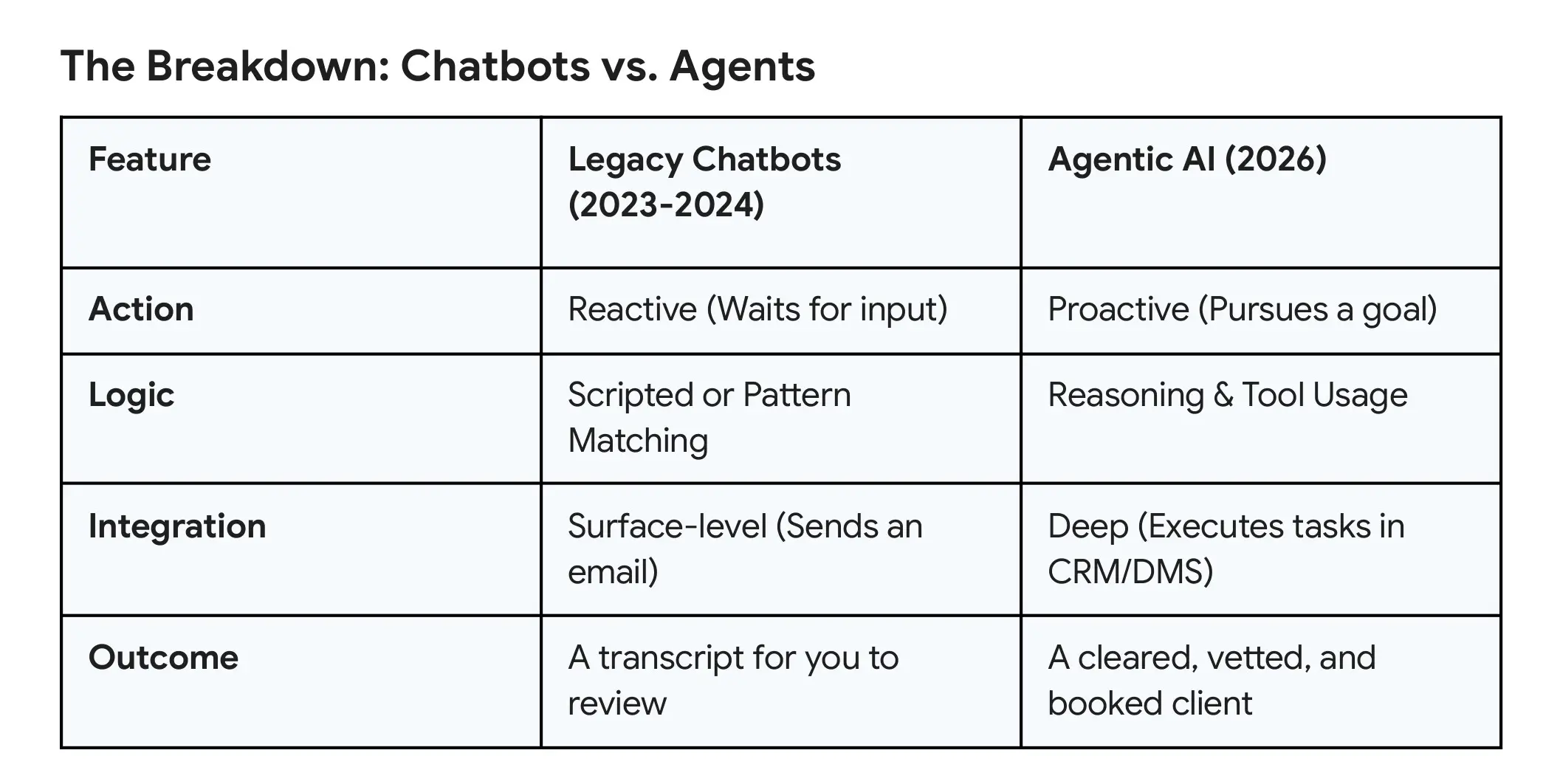
A traditional chatbot, even a modern LLM-powered one, is reactive. It responds to input. It collects data according to a script and deposits that data somewhere for a human to act on. The decision-making still sits with your staff.
Agentic AI is different in one critical way: it pursues a goal. Instead of collecting information and stopping, an agentic system reasons about what to do next and executes those steps autonomously, across multiple tools and platforms, without waiting for a human to move the lead from one stage to the next.
The 2026 Agentic Intake Workflow: What Actually Happens
Here is what an agentic intake process looks like in a law firm that has the right CRM infrastructure in place. A lead submits a form at 11 PM on a Sunday. No one on your team is awake. Here’s what happens next.
Step 1: Goal-Oriented Qualification
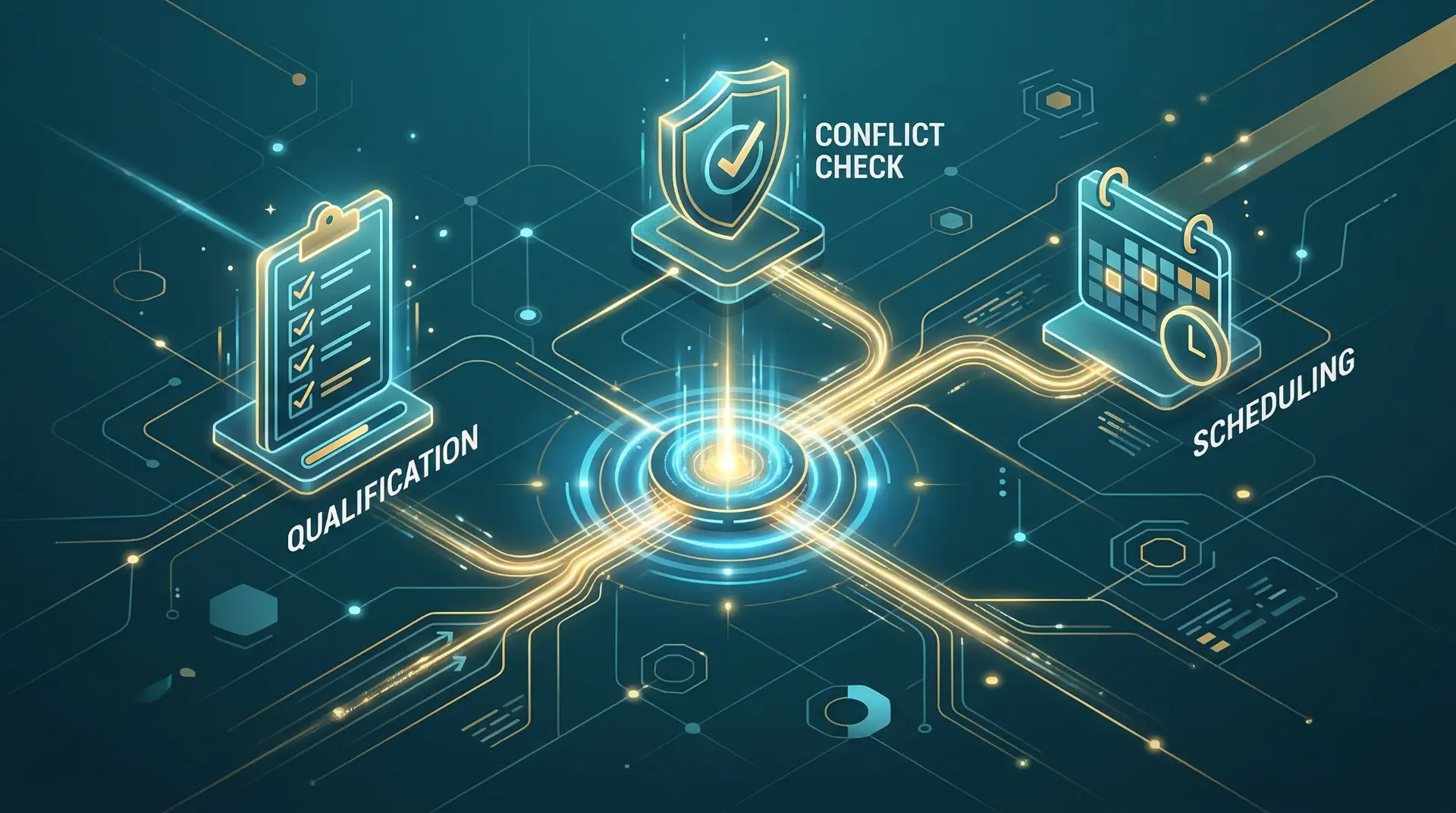
Instead of a static form, an AI agent runs a dynamic qualification conversation based on your firm’s specific intake criteria: the practice areas you take, the injury thresholds you require, the jurisdictions you’re licensed in. It doesn’t just record answers; it evaluates them against your rules in real time.
If a lead discloses a car accident that happened four years ago in a state with a three-year statute of limitations, the agent flags the issue, explains the problem, and can route the lead to a referral partner rather than leaving them in a dead-end queue. This requires your CRM to hold a clear, configured version of your Ideal Client Profile, not just contact fields, but qualification logic that the agent can actually execute against.
Step 2: Autonomous Conflict Checking
Historically, conflict checking is where intake speed dies. A staff member pulls the lead’s information, logs into the case management system, runs a manual search, and documents the result. In a busy firm, that step alone can take 24–48 hours.
In an agentic system, once intake is complete, the agent queries the firm’s client database via API, checks for potential conflicts (for example, whether the opposing party is a current client), and routes the intake packet to the appropriate attorney, all without a single human click. For this to work, your CRM or case management system (Clio, HubSpot, GHL, or whichever platform you use) must be properly connected via API. A disconnected or poorly configured CRM means the agent cannot run this step and the bottleneck remains.
Step 3: Precision Scheduling
This is where most firms stop at “good enough,” a Calendly link in an automated email. But a Calendly link has no intelligence. It doesn’t know that your senior partner only takes high-value consultations on certain days, that you need buffer time between calls, or that a particular practice area requires a specific intake team member.
An agentic scheduler applies your firm’s actual booking rules, checks real-time calendar availability, and books the right consultation with the right person at the right time, all within the same session that the lead submitted their initial form. The lead goes from “I need a lawyer” to “I have a confirmed appointment” without your staff touching anything.

The Part Nobody Talks About: CRM Readiness
Here is the uncomfortable truth about agentic AI for law firm intake: the AI is only as good as the infrastructure it runs on.
Every step in the agentic workflow described above depends on your CRM and case management system being properly integrated, configured, and maintained. If your HubSpot has duplicate contacts, if your GHL pipelines are misconfigured, if your Clio integration is broken or missing, the agent cannot do its job. You don’t get autonomous intake. You get an expensive tool that produces unreliable output.
This is consistent with what analysts are finding across the industry: Gartner projects that over 40% of agentic AI projects will be canceled by 2027 due to escalating costs, unclear business value, or inadequate infrastructure and risk controls. In our experience working with law firms on CRM implementations, the failure mode is almost always the same: the AI layer gets deployed on top of a broken or misconfigured CRM, and the whole system underperforms.
Before your firm can realistically deploy agentic intake, you need to audit five things:
Contact data quality: Are duplicates cleaned? Are fields standardized?
Pipeline structure: Do your intake stages map to real workflow states?
Integration health: Are your tools actually talking to each other in real time?
Qualification logic: Is your Ideal Client Profile documented and translatable into rules?
API access: Can your case management system be queried programmatically for conflict checks?
If the answer to any of those is “no” or “I’m not sure,” agentic AI will not save your intake process. Fixing the foundation first is not optional.
The Role of the Lawyer in an Agentic System
One of the most common concerns managing partners raise about autonomous intake is loss of control. What if the AI qualifies a bad case? What if it misses a conflict?
The answer is that agentic AI doesn’t remove the lawyer from the process; it changes where the lawyer’s judgment gets applied. As analysts have noted, what definitely won’t happen is the total removal of humans from high-stakes, complex legal work. What changes is when human judgment enters the picture.
In a well-configured agentic system, the attorney sets the rules upfront (qualification criteria, conflict parameters, scheduling constraints) and the AI executes within those guardrails. Every action the system takes is logged with transparent reasoning. You can audit any decision. You can move from managing the process to governing the policy. That is a more leveraged use of a lawyer’s time and it scales.

Speed-to-Lead Is Now a Structural Advantage
According to the 2024 Clio Legal Trends Report, only 40% of law firms answer phone inquiries, down from 56% in 2019. Meanwhile, according to Martindale-Avvo’s Legal Consumer Report, 80% of consumers will contact another attorney if they don’t hear back within 48 hours.
Agentic intake collapses that response window to seconds. A lead who submits a form at 11 PM on Sunday receives an immediate, intelligent response: one that qualifies their case, confirms there’s no conflict, and books them a consultation for Monday morning. By the time your staff arrives, the work is done.
Thomson Reuters’ 2025 Generative AI in Professional Services Report shows active AI use among legal organizations jumped from 14% to 26% year-over-year, with 78% of law firms believing AI will become central to their workflow within five years. The firms adopting it now are not just getting operational efficiency; they are locking in the best cases before competitors even wake up.
What This Means for Your CRM Stack in 2026
Whether your firm runs HubSpot, GoHighLevel, Clio, or a combination of platforms, the strategic question is the same: is your CRM built to support autonomous action, or just to store data?
A CRM that supports agentic intake has clean data, real-time integrations, properly mapped pipelines, and documented rules that a system can execute against. A CRM that doesn’t support it is a filing cabinet: useful, but not a growth engine.
At Wacmediya, we work specifically with law firms on CRM integration and automation, building and fixing the infrastructure that makes systems like this actually function.
FAQ: Agentic AI for Law Firm Intake
Is agentic AI intake safe for confidential client data?
Yes, when deployed on professional-grade platforms built for the legal industry. Look for SOC2 compliance and clear data residency policies. Avoid consumer-grade AI tools for anything involving PII or case details.
Does this replace my intake team?
No, it reassigns them. Intake staff shift from data entry and phone tag to high-touch conversations with leads the system has already vetted. Most firms find this improves both morale and conversion rates.
What CRM platforms support agentic intake workflows?
Several platforms used by law firms, including GoHighLevel, HubSpot, and Clio, can support agentic workflows when properly configured and integrated. The platform matters less than how well it’s built out and maintained.
What if the AI makes a wrong qualification decision?
Well-implemented agentic systems log every decision with reasoning you can review. You can configure human-approval requirements for borderline cases or high-value matters. Transparency in the decision trail is what separates professional-grade systems from consumer tools.
How long does it take to implement agentic intake?
The AI configuration itself can move quickly. The CRM remediation work that usually needs to happen first (cleaning data, fixing integrations, mapping pipelines) typically takes 4–12 weeks depending on how much technical debt exists in the current setup.